Our perverse economic system needs an overhaul
Our economic paradigm rewards profiting from war while destroying lives and ecosystems. We created this paradigm and we can change it.

If you subscribe to Changing Stories, you know that I am a glass half-full type of person. I believe there are many reasons to be hopeful and to emphasise positive narratives. Nonetheless, I am frequently filled with despair at the rotten and perverse economic system we have co-created. The recent disclosure of the astounding profits that oil companies have accumulated as a direct result of the Iran war, while many of us are experiencing a dystopian summer, was a case in point.
This Substack series is informed by the research for my upcoming book, Changing Stories, Finding Hope, which looks at the way negative – and flawed - narratives shape our perception of the world we live in and our ability to imagine and create a more positive future. For more background please read - or listen to - my introductory Substack.
According to the Journal Nature, 210,000 more people have died from heat-related causes each year from 2012-2021 compared to 1990-1999. Just under 3,000 people have died in England as a result of the May and June heatwaves. That is before the worse July heatwave was factored in. We are so used to having numbers thrown at us that it is quite easy to gloss over these, but each of these is a child, parent or grandparent who is no longer with us because of the extreme heat.
We also know what caused this: rampant climate change caused by human activity, in particular CO2 and methane emissions. Until recently we could have thought that climate change was a distant prospect which we may need to do something about one day, once we’ve addressed other, ‘more urgent’ priorities.
The evidence is undeniable: That day is here. The planet is warming to increasingly extreme levels, people are dying as a result, entire ecosystems are being destroyed by wildfires – including ‘wet’ Scotland - while much of Western Europe is in drought, resulting in water shortages, crop failures and food insecurity.
Which brings me to the most recent reason for my despair: The news that the eight largest oil companies (Aramco, BP, Shell, Equinor, TotalEnergies, Eni, Chevron and ExxonMobil) have made over $90Bn in profits as a result of the Iran War and the closure of the Straight of Hormuz. That is more than $700,000 per minute between March and June.
I guess that if you are an executive or a shareholder of one of these companies that is wonderful news, but to me the whole thing seems outlandish. We have created a system whereby a group of companies can reap extraordinary financial rewards from wars - that are caused by our dependency on their product - while also being responsible for significant environmental and public health damage, not to mention a cost-of-living crisis. How did we arrive at such a ridiculous, dangerous and perverse system?
Who’s to blame?
I don’t blame the executives who lead these organisations. If their actions are measured by how these actions contribute to shareholder value, their focus will be on that single indicator, and they will become blind to other considerations. Furthermore, in my numerous interactions with them over the years, I have often noticed that people who work for oil companies also take great pride in their product, which has helped humankind progress in many ways over the past century. This pride makes them less open to alternatives. But that was before we really understood the inherent risks, and before the advent of credible and cost-effective alternatives.
I don’t blame the governments for failing to act, as they are trapped in a flawed narrative, believing that growing the economy is their primary responsibility, making them biased in favour of those who they believe can deliver this growth: corporations and financial institutions. Corporate money buys access to political power and the ability to unbalance the playing field in favour of corporations’ never-ending pursuit of shareholder value.
Governments are not helped by an electoral cycle that rewards short-term firefighting over structural change. This leads to the Kafkaesque logic which argues that the UK should reopen exploration of North Sea oil and gas fields at Rosebank and Jackdaw to guarantee energy security and affordability. All the fossil fuels in the North Sea will achieve neither, as prices are set globally and have nothing to do with local supply, while genuine energy security can, by definition, only be delivered by renewable resources, not finite ones.
Nor do I blame the users of energy – businesses and private consumers - who continue to purchase fossil fuels. Their hands are often tied by financial considerations, such as access to the upfront capital required to transition to renewables, while they are also misinformed by the media and the corporate PR machine.
Each of the above may be responsible for perpetuating this perverse system, but they are not to blame because they are all acting in a logical way within that system, and the flawed narratives that support it. In other words, they are doing the wrong things for what they believe to be the right reasons.
I could blame those who created the system, the neoliberal economists such as Hayek and Friedman who developed the theory, or the politicians, led by Reagan and Thatcher, who translated this theory into policy in the 1980s, normalising an extreme economic theory. This resulted in an open attack on the fabric of society through deregulation, tax cuts for larger business and the ultra-rich, the privatisation of public services and the resulting cuts in public spend. I could blame them, but they are all dead, so why bother?
What can be done?
So, let’s forget blame and instead focus on what can be done, which requires looking at the immediate issue of war profiteering as well as the underlying narratives that have made this possible, and will continue to do so if we don’t address them.
First, how do prevent oil companies from profiting from war?
One approach that you will have heard a lot about recently is to tax oil companies’ excess profits, also known as a windfall tax. An example of this is the UK’s 2024 Energy Profits Levy which sought to tax companies benefiting financially from Russia’s invasion of Ukraine. This is a useful tool, but politically complex for the reasons I outlined above, so should be embedded in long-term policy rather than require a political decision in each instance.
While this is a short-term solution, it does not provide long-term relief as long as our economies remain addicted to fossil fuels. How these additional tax receipts are spent therefore matters as much as collecting them. Specifically, the revenues should not be used to plug short-term funding gaps, but directed towards building a renewable, low-carbon energy infrastructure which increases energy independence and reduces our dependency on fossil fuels. This should include:
Growing renewable electricity production and storage, both locally (residential and industrial production) and across the national grid.
Enhancing the provision – and reducing the cost - of low-carbon transport: public transport, cycling and affordable electric cars
Building greater resilience to the changing climate, for instance through insulation and flood protection
Outside of energy use, we also need to reduce our dependency on petrochemicals used in the plastics and fertiliser industries by promoting alternative materials, strengthening a circular economy and supporting regenerative agriculture.
Done well, these measures will help create a safer world, but if we want to create a better world, we also need to address the underlying belief system that normalised such a perverse system. Specifically, we need to actively question our obsession with economic growth and its indicator, GDP (Gross Domestic Product). As I have written in a previous piece, GDP neither measures what matters to people and planet, nor is it physically compatible with our finite system, the Earth. Instead, we need to measure and deliver what really matters: Wellbeing within planetary boundaries. Both wellbeing and planetary boundaries can be measured. As governments ask themselves what will replace the deteriorating post WW2 world order, perhaps now is the perfect time for a radical rethink?
I remain hopeful.
I will be away next week enjoying some time roaming around the UK and performing with the Magnificent Kevens at Beautiful Days festival. To say I’m looking forward to it is an understatement…
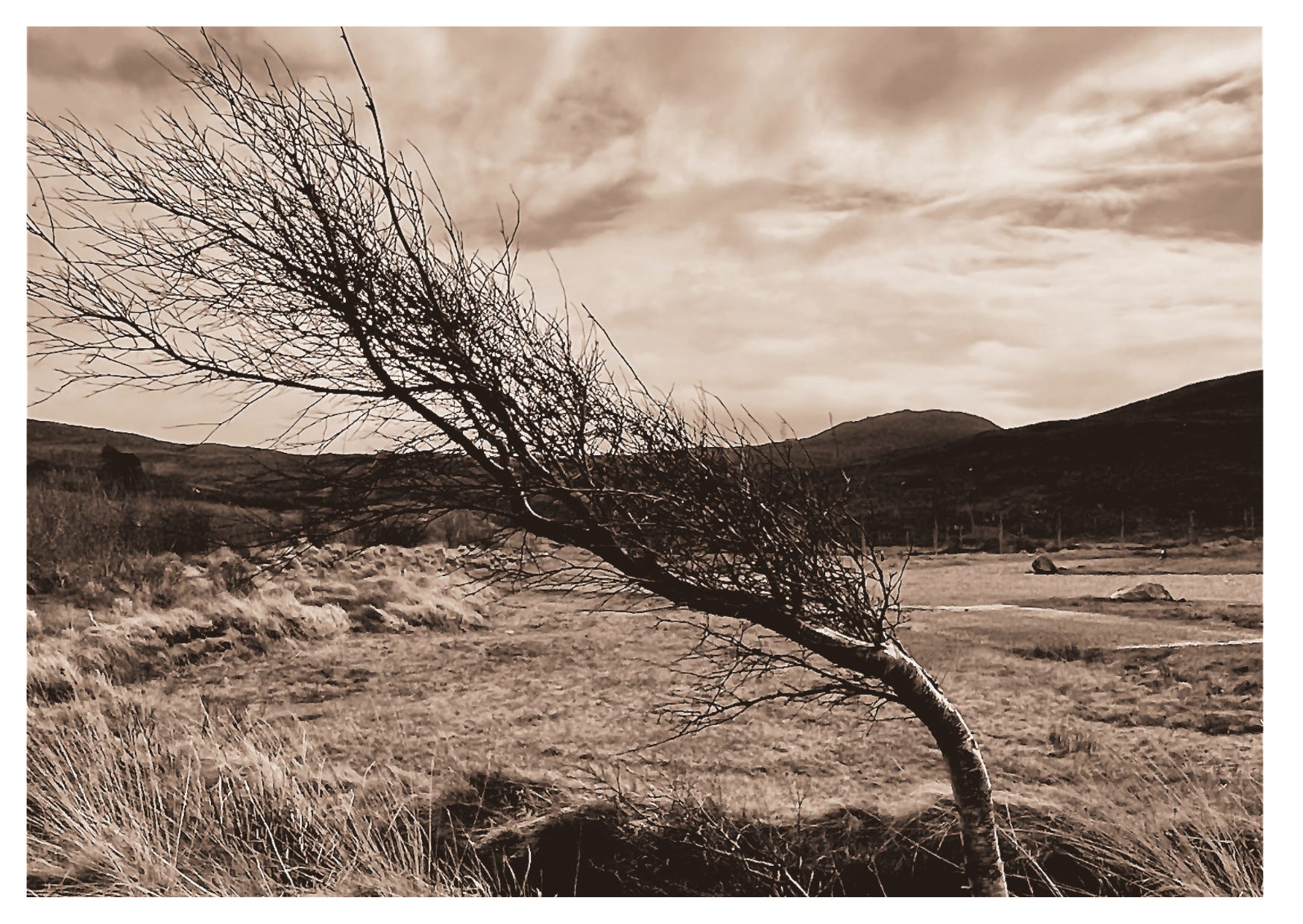
This week’s photo was taken by Maia during a recent trip to the Coigach Peninsula.