Why competition is harming us
Competition is a choice. So is collaboration. Let’s make better choices.

This Substack series is informed by the writing of my upcoming book, Changing Stories, which looks at the way negative – and flawed - narratives shape our perception of the world we live in and our ability to imagine and create a more positive future. For more background please read my introductory Substack.
I got an email from Meta this morning asking me if I was ‘Wondering what my competition is doing?’
My wife Maia and I reluctantly use Meta to promote gigs we are hosting in Highlands, largely because Facebook is the most used platform for communities to connect and promote events in the region. If you want people to know what you’re up to, you need to use FB.
But do we ever wonder what our competition is doing? Never. We don’t see other promoters as competition, we see them as people with a shared love of music who are trying hard to keep music alive in these challenging times for musicians.
Yet the spirit of competition is alive and well. It dominates most human interactions. But of course, that is normal I hear you say. Competition is a critical part of the evolution of all species, including our very own homo sapiens. Darwin said it first in his ‘survival of the fittest’ theory. Except Darwin said nothing of the kind. His main contribution to evolutionary science was the concept of natural selection which he first described in ‘On the Origin of Species’ published in 1859. Darwin believed that evolution of species came about through a combination of three factors:
Inheritance, aka our genes
Variation, the small variations that occur by chance in our genetic makeup
Struggle for existence, which occurs because any species’ survival is limited by the environment around it. This is where the small changes in our genetic traits might favour one mutation over another, helping it carry its genes to the next generation.
Competition is everywhere
The term ‘survival of the fittest’, often mistakenly attributed to Darwin, was actually coined by Herbert Spencer, a Darwin contemporary, to describe biological processes, but his perspective was as much ideological as it was scientific, and he is best known for developing what later came to be known as ‘Social Darwinism’, using biology to redefine how we think about human society. This opened the door for the dominance of competition as one of the defining principles of human interaction. It has enabled a dog-eat-dog narrative where we are told we must constantly compete, between nations, between businesses and with each other.
My first job was as a research analyst for one of the world’s leading strategy consultancies, which like many of their peers, favoured a pyramid organisational structure with a large pool of juniors being gradually reduced as they climbed the organisational ladder where, if they were lucky and worked hard enough, eventually made partner. ‘Up or out’ – or ‘rank and yank’ as GE’s Jack Welch called it - is a model that works well, and promises great riches for those who make it, but it also generates extreme competition between those climbing the ladder, undermining human relationships and collaboration. Of course, many measures are put in place to mitigate this, but the underlying principle – compete or lose – remains. I soon realised that this wasn’t how I wanted to develop professionally, or perhaps I just wasn’t good enough to compete. In any case I spent the next 15 years working for dedicated sustainability think-tanks and consultancies, where ‘up or out’ was both irrelevant given the size of these boutique organisations, but also in conflict with the sustainability mindset.
As I created my own non-linear career pathway, helping companies embrace sustainability, I noticed another interesting quirk in many of the organisations I worked for and advised: An obsession with the competition. I used it to great benefit when trying to promote sustainability initiatives: If my organisation - or my client - weren’t particularly supportive of a suggested sustainability initiative, all I needed to do was show that their competitors were already doing it and suddenly the initiative was approved. The business case didn’t matter, the sustainability imperative didn’t matter, what mattered was that they didn’t want to be left behind by their competitors.
This competitive mindset is also reflected in the idiom of business, where ‘war rooms’, ‘pricing wars’, ‘hostile takeover’ and the constant ‘battle for market share’ abound.
Finally, the news agenda is dominated by competition. We justify war to secure resources in a competitive world where no other nation can be trusted, to maintain power in a hyper-competitive political landscape and we spend billions on a nuclear arms race that can kill most people on earth, ironically to keep the peace…
Trump close advisor Stephen Miller captures this chillingly in a recent interview with CNN’s Jake Trapper (@5’50”): “We live in a world in which you can talk all you want about international niceties and everything else. But we live in a world, in the real world, Jake, that is governed by strength, that is governed by force, that is governed by power.”
If you believe that, then the only response is to compete even harder. But Miller’s words are just an interpretation to suit his and his paymaster’s political agenda, aka propaganda. There is no doubt that the competition narrative is ubiquitous, that it has played an important part in human history and that it is a part of human nature, but it does not need to be the dominant narrative.
Why the competitive mindset is flawed
Herbert Spencer’s interpretation, and those that came after him, is flawed, from a biological, and a sociological perspective.
Life did not take over the globe by combat
Darwin never implied that the ‘struggle for existence’ only occurred as a result of competition. He believed that cooperation was equally important. In the ‘The Descent of Man’, Darwin writes that “Those communities which included the greatest number of the most sympathetic members would flourish best, and rear the greatest number of offspring”, where ‘sympathetic’ specifically means capable of caring behaviour.
One woman who helped shaped a counter-narrative was Lynn Margulis. In 1966, she defied gender and scientific barriers by publishing a paper that proved life on Earth was the result of extensive cooperation between cellular organisms, enabling them to merge and evolve into what eventually became visible life on earth. Her work was initially ridiculed, but she persisted, and by the 1980s was vindicated. As she put it eloquently, “life did not take over the globe by combat, but by networking”.
More recent findings also confirm that a competitive mindset is only a small part of human nature, and that the underlying culture is a stronger determinant of our willingness to compete rather than cooperate. While our competitive disposition is partly inherited, which might support the idea that it is part of our nature, the underlying culture plays a greater role. Even people with highly individual traits - and therefore more likely to compete - behave cooperatively when placed in a cooperative culture.
Competition is killing us
Competition in markets is the best way to generate better outcomes for society as it ensures that businesses are constantly seeking to improve and reinvent themselves in order to win market share. Or so the story goes.
In her book ‘Competition is Killing Us’, competition lawyer Michelle Meagher makes a compelling case against competition in markets. Her core arguments run as follows:
Free, competitive markets are anything but free. Instead, they enable the concentration of power. See for instance the way technology companies have, thanks to the enabling power of free, ‘competitive’ markets, come to dominate the cultural and political landscape. We might have free markets, but it remains to be seen whether we have free politics.
Free markets are not benefitting consumers or society. If price is the only measure of the success of competition, you could argue competition has on the whole been successful. But consumers and society are paying the costs of free market competition in many other ways, through poorer service, price fixing, the perversion of the commons to deliver shareholder value,... The list goes on as I wrote a couple of weeks ago when highlighting the dreadful plight of the UK water industry.
Planetary-scale collaboration
To cover the geopolitical nature of competition, and how it is shaping a world in constant conflict, I would like to close with a quote from Thomas Friedman’s stunning New York Times article ‘Why Minnesota Matters More Than Iran for America’s Future’. The article, which contrasts the behaviour of ICE agents with the cross-community spirit that has arisen in Minnesota, concludes as follows: “All the big existential challenges humanity faces today are planetary in scale — how to manage A.I., climate change, nuclear proliferation, pandemics and global migrations with so many people on the move. All of these challenges require planetary-scale collaboration. Either we figure that out soon — or we’re heading for a really bad century together.”
Competition is not a necessary reality. It is a choice, a narrative we have chosen to believe. We can choose a different narrative.
For the future of our planet and its people, let’s compete less and collaborate more.
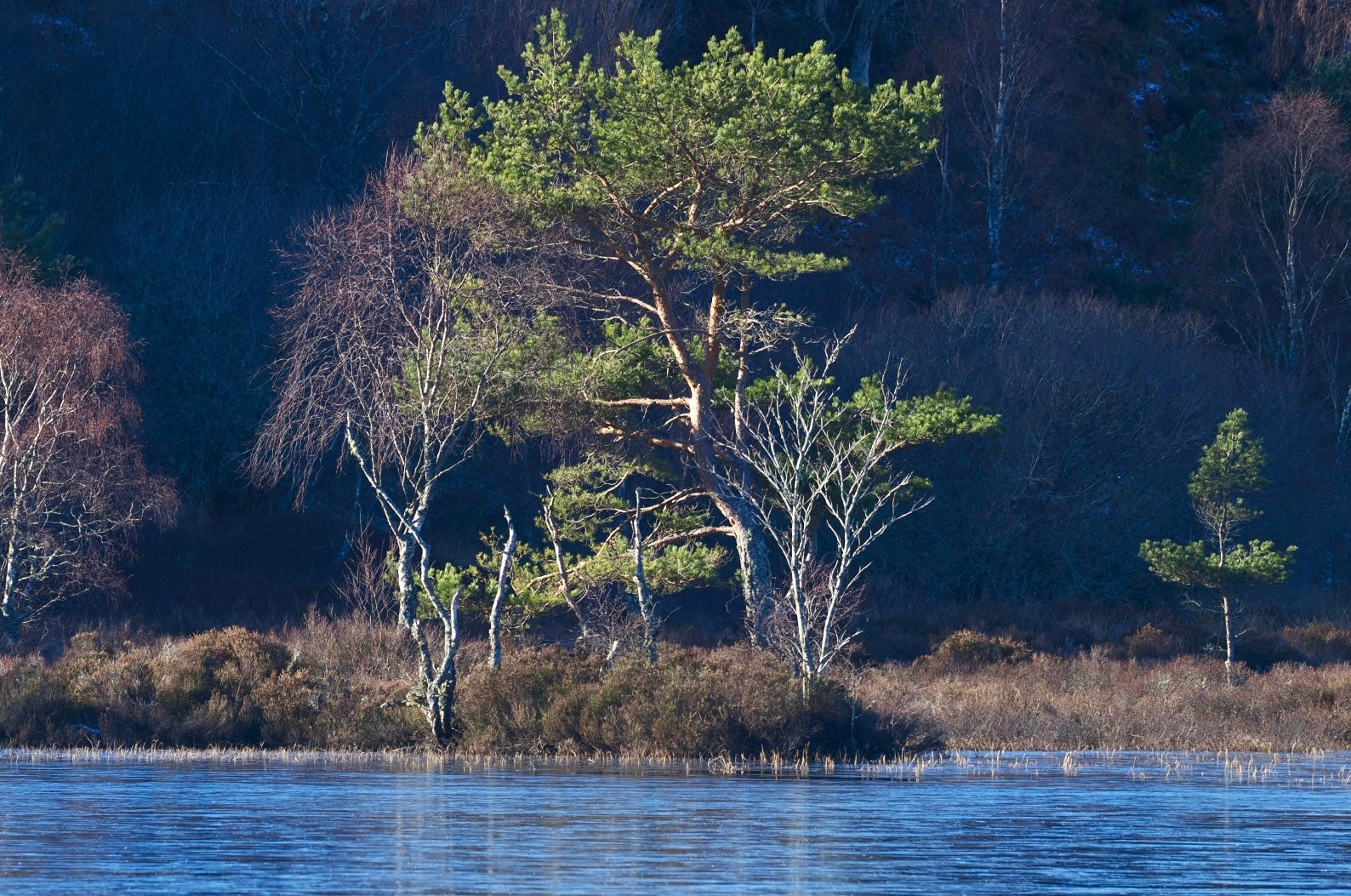
This week’s photo is of a Scots Pine and its progeny, on the shores of Loch Ruith à Phuill.