
Less is more. Really.
Our growth economy might depend on us consuming more, but we don't.

As I set about researching the chapter of Changing Stories that tackles the consumerism narrative, I thought I’d lay down my hypothesis, or what I believe about consumerism and human wellbeing. To do this I will draw on the work of the brilliant Chilean economist Manfred Max-Neef.
This Substack series is informed by the research for my upcoming book, Changing Stories, Finding Hope, which looks at the way negative – and flawed - narratives shape our perception of the world we live in and our ability to imagine and create a more positive future. For more background please read my introductory Substack.
The average adult American spends about 40 minutes per day looking at ads. Extrapolate that to an average lifetime and it turns out we spend about 2 years watching ads. We also spend 3 years on social media, which includes a lot of ads. These ads must work as we spend a staggering 8.5 years of our lives shopping.
In other words, we spend close to 15% of our time on earth buying stuff or consuming content that entices us to buy stuff. I am just as guilty as the next person, and remain firmly within the grasp of our consumption narrative: My vice is music and books and the odd technological fix that will finally turn me into a decent musician. At times I just can’t stop myself, convinced that if I don’t have this book my quality of life will be less. Said book dutifully arrives, gets added to the pile of books I need to read, whether for pleasure or research, and quite often stays there, untouched for months if not years. And yet I managed to convince myself that I needed it there and then!
And while I don’t spend that much time on social media, I am in the thrall of technological dopamine hits, feeling that little buzz of excitement every time I open WhatsApp, Signal or email. What is the latest band chatter? Has someone new subscribed to my Substack? As I wrote last week, that need for dopamine can sometimes put me in a state where I am constantly checking chats, emails and news in the hope something positive might appear. It has a way of pulling me in, in spite of myself. You’d think it was intentional…
If we spend over 10 years of our lives consuming stuff and content, it must be good for us, right? Not really. Not all that we consume is critical to our wellbeing or enables us to meet our fundamental human needs. This begs two questions: What are our fundamental human needs, and can consuming help us meet these needs?
What are our fundamental human needs
All humans across time and cultures have the same needs. This is something that two of the main thinkers in this space agree on. You’re probably familiar with the work of Abraham Maslow and his hierarchy of needs, but I have always been more drawn to the work of Chilean economist Manfred Max-Neef.
In his 1986 book ‘Human-scale Development’, Max-Neef sought to develop an alternative approach to economic development, one that was not reliant on international trade and export and was neither on the extreme right (neo-liberalism) or left (communism) of the economic-political spectrum. He argued that development needed to be at a human scale, geared towards satisfying human needs. In his research he developed a definition of nine fundamental human needs:
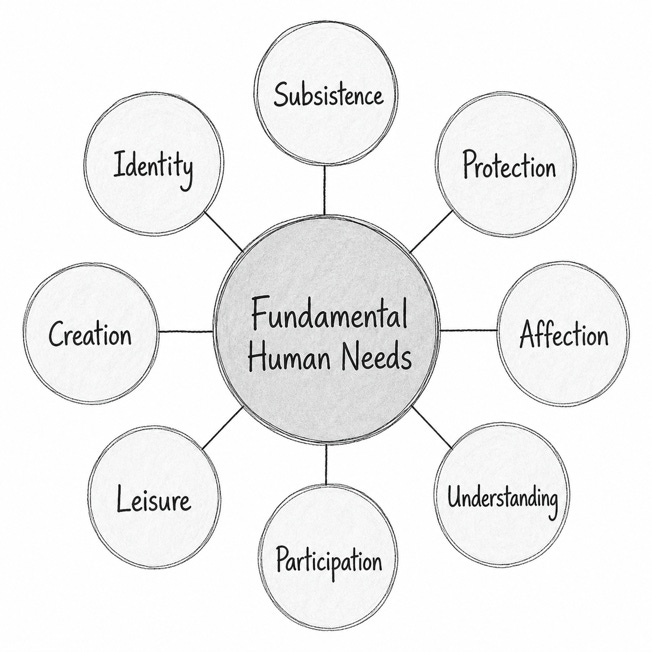
Subsistence: Health, food, water, and shelter.
Protection: Security and safety
Affection: Love and companionship
Understanding: Learning and knowledge
Participation: Being involved in decisions that affect our lives
Leisure: Free time to relax and reflect
Creation: Expressing ourselves through art, design, or invention
Identity: Identity and belonging
Freedom: Being able to choose how we live our lives
In contrast to Maslow, Max-Neef did not believe there was any type of hierarchy between these needs, apart from the need for subsistence, but both agreed that fundamental human needs do not change between cultures or historical periods. Whether you are a Wall Street investment banker or an indigenous Yanomami from the Amazonian rainforest, whether you were alive in the middle-ages or in the 21st century, your fundamental human needs do not change.
Which brings us to the second question.
Can consuming help us meet these needs?
So, we all have the same needs, but where we disagree is in how we meet these needs. One of the real innovations in Max-Neef’s thinking is the concept of satisfiers, the ways in which we satisfy our fundamental needs. These satisfiers vary significantly between cultures and time periods.
Max-Neef identifies 5 different types of satisfiers:
Destructive satisfiers: They supposedly satisfy one need, but impair the satisfaction of other needs. Example: Smoking can help us pause and satisfy our need for leisure, but ultimately undermines our survival need.
Pseudo-satisfiers: They seem to satisfy a need, but the outcome is either false or short-lived. Example: ‘Fast’ purchases, such as fast fashion, give us a temporary sense of identity which is very quickly erased.
Inhibiting satisfiers: By satisfying one need, they impair the possibility of satisfying other needs. Example: Our consumption of social media might provide us with a bit of leisure, but undermine our sense of identity, participation and affection.
Singular satisfiers: They satisfy one need, but have no impact on other needs. Example: Buying staple foods for personal consumption (as opposed to sharing with others) meets our need for subsistence, but no other.
Synergic satisfiers: They satisfy one need and contribute to the satisfaction of other needs. Example: Buying food to share with others meets our need for subsistence, leisure, identity and affection.
Simply put, unless our consumption drives singular or synergic satisfiers, they don’t contribute to meeting our needs or increasing our wellbeing. In fact, they often do the opposite.
To help me understand what that looks like in practice, I really valued Nate Hagens’ recent Substack piece entitled The Consumption Pyramid. In this essay, Hagens identifies seven layers of consumption.
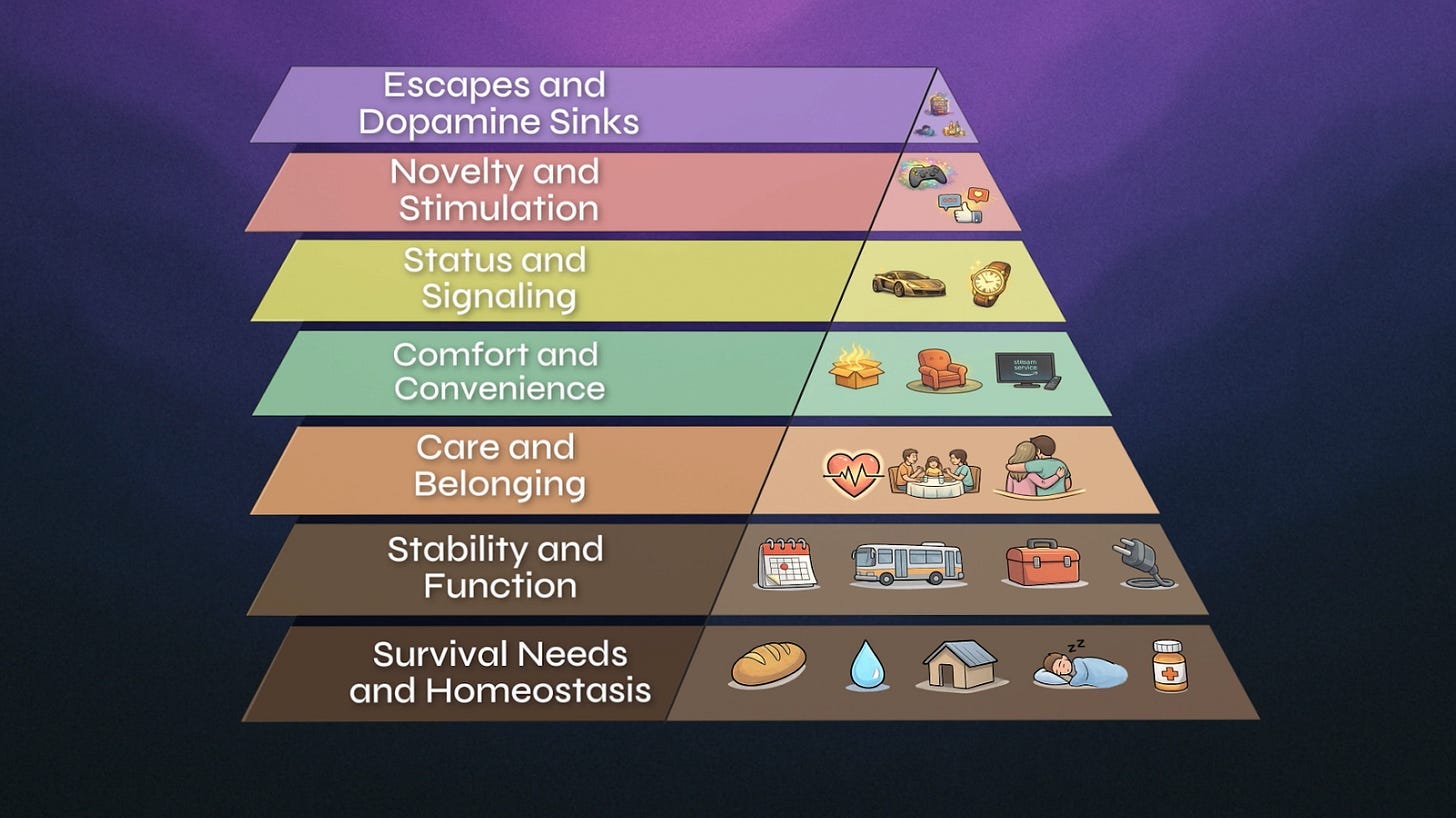
The first three layers are what is needed for a decent and happy life: Meeting basic needs, ensuring we can function in the way we choose, and that we have meaningful relationships. All of these are strongly correlated with Max-Neef’s universal needs and are typically conducive to greater levels of human wellbeing.
(At this point I should add that meeting our basic needs is sadly not a given for most of the human population, something I shall address in a later article).
For those of us fortunate enough to be able to access those things needed for a happy life, this is where things get more complicated. Once our basic needs are met we may start consuming other things, often because of external influences that tell us we don’t have enough status, power, money, beauty, fame, …
Not all of us are drawn to these external factors, but both our growth economy and the consumer society that feeds it, depend on us being hooked to them. Why? Because they are strongly correlated with the consumption of material goods.
Psychologists call these extrinsic values, which focus on external rewards and approval, in sharp contrast to intrinsic values, which offer inherent satisfaction without the need for external recognition. Examples of these include healthy relationships, helping those within our community, exercise, experiencing art, making music, …
Advertising and social media work very hard to reinforce our insecurities by telling us we’re not good enough because we don’t have the latest phone, aren’t attractive enough because we don’t wash our hair with the right product or won’t find freedom because we don’t have the right car. The success of our consumer society shows that they are extremely good at it, because ultimately they are selling us a lie, and we buy it. Tim Jackson sums it up perfectly: “People like us are being persuaded to spend money we don’t have, to buy things we don’t need, to create impressions that won’t last, on people we don’t care about.”
By following extrinsic goals, we are drawn into this crazy narrative. And it gets worse, because chasing these goals makes us less happy: our needs are never satiated and we become dependent on the judgement of others, constantly questioning our own worth. This leads to greater anxiety and a reduction in the quality of our relationships.
In contrast, pursuing intrinsic goals are likely to result in greater life satisfaction, because these goals are mutually supportive and readily available, such as community spirit, strong relationships or access to nature. They also give us a greater sense of purpose, another key determinant of happiness.
And if that isn’t enough, there is the significant environmental footprint associated with the more materialistic, extrinsic values. The sad truth is that with the possible exception of locally grown organic fruit and vegetables, all of our purchases have a negative environmental footprint. But some goods are necessary to meet our basic needs, while others – those in the top 4 layers of Hagen’s pyramid - are usually not. Yet it is this latter category that is responsible for the greatest environmental impact. For instance, the richest one percent of the global population emit more than twice the amount of CO2 than the poorest 50 percent.
If consuming beyond our basic needs is based on a lie, makes us less happy and is destroying the planet, why do we do it?
That is the question I will seek to answer over the next few weeks. Watch this space.
This week’s photo is from a dramatic Highland sunset taken around 22.30 last week.

We've been running our Black Isle Library of Things for just over a year now. We have over 600 items listed, all donated by people who either weren't using them any more or only used them occasionally and knew they could borrow them back when they needed them. One of the outcomes is that those in the community who had too much stuff and were burdened by it or were clearing out relatives' life time accumulations now have more space/ feel their relatives' possessions are being put to good use and those who couldn't afford or couldn't justify buying something now have easy access to the wide range of community resources. We've saved things going to waste and our community feels richer having access to more but without the need to buy. We now have 91 members not counting visitor members who have hired bikes but only stay on the system a short time. I spoke to someone this week who says they have an informal version in her cul-de-sac in Glasgow. Everyone knows where to go to borrow what they need and knows that if a neighbour gets something they won't need to. This is perhaps something we've lost from our communities and are now reinventing. The average electric drill spends just 20 minutes in use in its life time!